

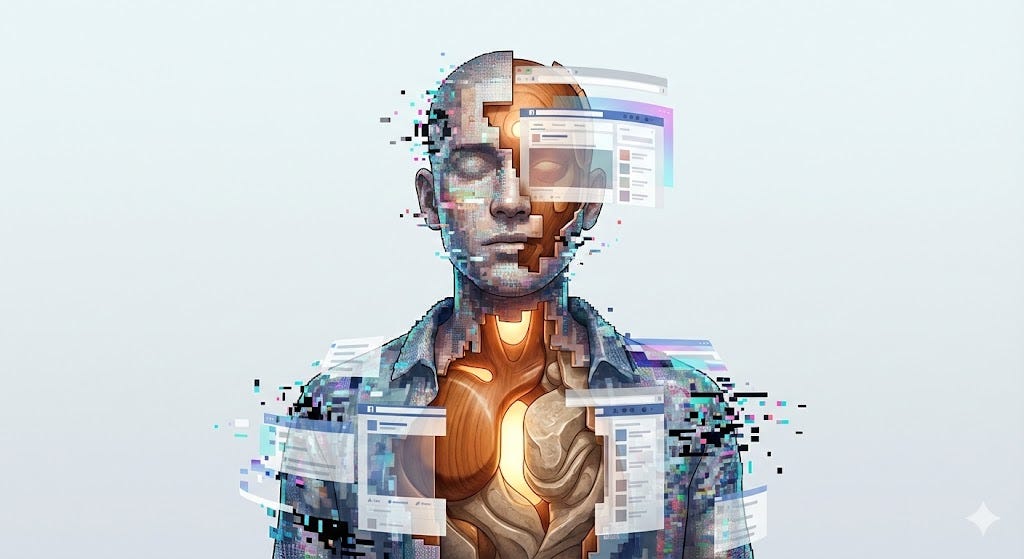
I used to think the problem was change. That if things would just slow down, we’d all feel a little less insane.
But change has always been with us. What’s different now is that nothing carries forward.
We’re living in a world that updates like an app. Rules, norms, platforms, jobs, relationships, identities—everything ships new versions constantly. And if you’re not paying attention, life starts to feel like waking up each morning inside a brand-new reality, expecting us to perform like we’ve been training for it your whole life.
Here’s what I’ve noticed, both in myself and in the organizations I’ve worked with: continuity is quietly becoming one of our highest priorities. Not stability in the sense of nothing ever moves. Not nostalgia. Not “let’s go back to how things were.”
Continuity is something more useful. More urgent.
Continuity is coherence over time.
It’s the thread that stays intact while everything else moves.
Agency comes after continuity
Before this, I thought the highest emerging value would be agency. But agency needs a coherent self to do the choosing.
When the “who” is unstable, “what I do” becomes mostly a reaction to whatever is loudest, newest, or most emotionally charged. That’s not agency. That’s being programmable.
Memory is the medium of continuity. If you can’t connect decision to consequence, you can’t accumulate wisdom. You keep paying the price of the same lesson because it never gets stored in a form you can retrieve when it matters.
You’ve seen this in organizations: the company “learns” something in one quarter and forgets it in the next reorg. The work doesn’t compound; it resets. Not because people are stupid—because nothing carries forward.
The same is true personally. If you don’t keep a record of what you tried, what happened, and what you learned, your agency becomes a slot machine: pull the lever, hope for a better outcome, forget what you learned last time, repeat.
In some ways, we are actually not prepared for true agency.
The modern paradox: more options, less usable agency
We are living inside a strange paradox: the world is handing us more choices than ever, while simultaneously attacking the systems that make choices coherent—attention, memory, long arcs, shared reality.
So many people feel like this: “I can do anything… and I can’t do anything.”
The Real Scarcity
Information is everywhere. Opinions are everywhere. Content is everywhere. “New” is the cheapest substance on earth.
But coherence? That’s rare.
Coherence is what lets you trust a person. It’s what lets you learn without constantly starting over. It’s what lets a relationship deepen instead of stagnating or resetting. It’s what makes progress compound instead of evaporate.
Without continuity, life becomes a pile of moments that never add up.
And you can feel that cost. It shows up as anxiety, because your brain can’t predict the environment. It shows up as decision fatigue, because everything feels like the first time. It shows up as goal drift—you keep “getting serious” every Monday. Your story becomes a slideshow instead of a narrative.
The world doesn’t have to become calmer for you to have continuity. Continuity is what you build so you can stay human inside the chaos.
The Three Continuities
If continuity is coherence over time, humans usually need that coherence in three places:
Identity continuity: I’m still me. Not the same mood. Not the same energy. But the same core.
Memory continuity: My past is still usable. Not perfect recall—usable meaning. The ability to carry lessons forward instead of paying to learn them again.
Goal continuity: I’m still headed somewhere. Not rigid plans—direction. A thread of intention that survives contact with real life.
You can lose any one of these and still function. Lose all three and you feel like you’re living someone else’s life, in someone else’s feed, for someone else’s agenda.
Why This Matters More Now
A few forces are converging that make continuity feel less like a nice-to-have and more like a survival skill.
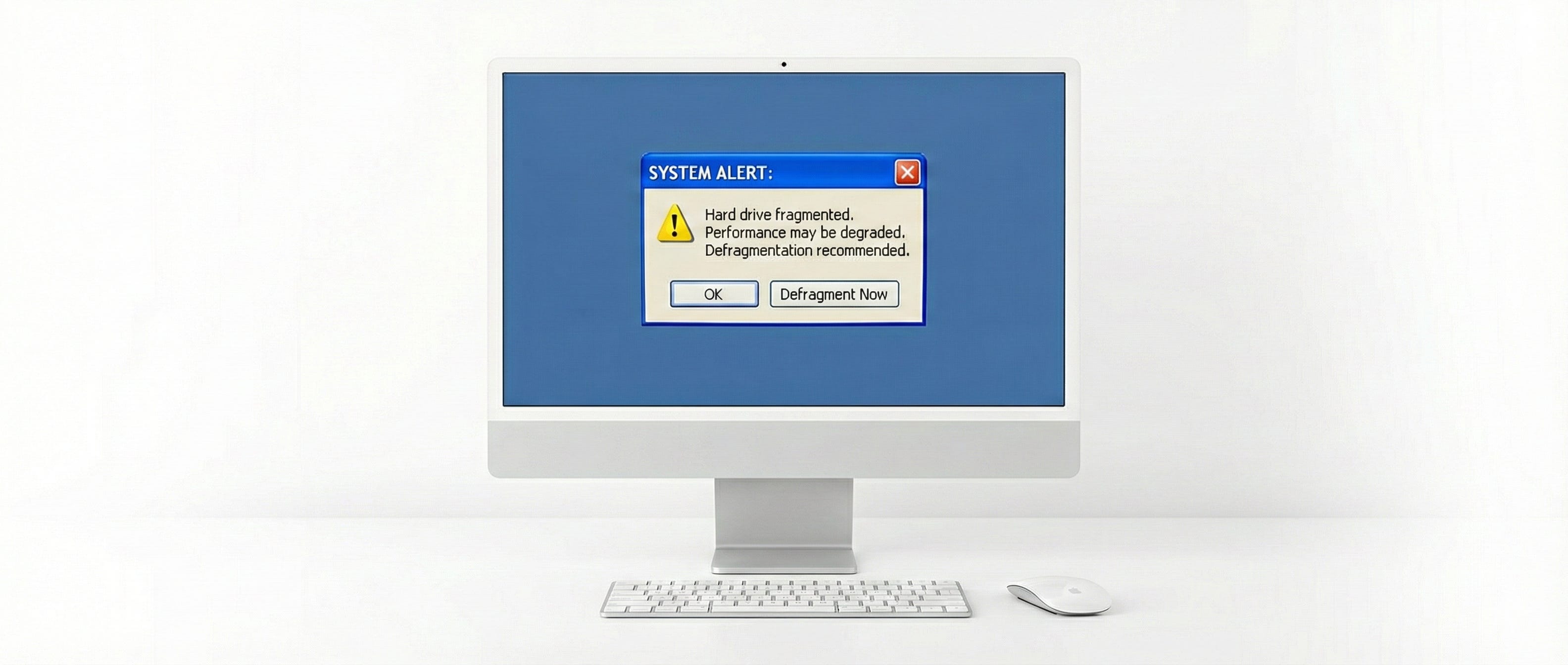
The world is updating faster than the nervous system. We’re running ancient hardware on continuously updating software. Your body is tuned for seasons and migrations, not notifications and terms of service updates. When the rules keep changing, your brain spends more time scanning for danger and less time creating meaning. Continuity becomes a form of psychological shelter.
Fragmentation isn’t just distraction—it’s identity erosion. The feed doesn’t only split your attention. It splits your self. When your inputs are fragmented, your inner world tends to fragment too. You think in clips, feel in bursts, choose in impulses. You become vulnerable to whatever is loudest, newest, most emotionally charged. Continuity becomes an act of self-possession.
Continuity used to be the default setting. Now we have to design it. For most of human history, continuity was baked into life: family proximity, stable communities, shared rituals, fewer choices, slower change. Now we’re mobile, remote, dislocated, personalized, sorted into niche realities. The new default is churn. Continuity becomes a craft—something you build intentionally, not something that happens to you.
When the tools are ubiquitous, and startup costs minimal, follow-through becomes priceless. Automation and AI are turning a lot of production into a commodity. When everyone can generate, the differentiator becomes: can you carry a thread? Can you sustain a relationship? Can you maintain a point of view? Can you build something across time? Can you keep promises—especially the quiet ones you made to yourself? In a world of infinite content, continuity becomes credibility.
Adaptive Continuity
I want to be clear about something: continuity is not rigidity. It’s not refusing to change. It’s refusing amnesia.
The version worth building is what I’d call Adaptive Continuity. Stable core, flexible edges. Values stay steady while strategies change. Identity deepens while goals evolve without evaporating.
Think of it like version control in software: you can revise, but you don’t lose the history or intent.
You’re allowed to pivot. You’re allowed to change your mind. Continuity isn’t “never change.” It’s “change without losing yourself.”
Where You Actually Have Agency
Here’s something useful: we don’t have equal control over every kind of continuity.
You have less control over emotional continuity than Instagram implies. Moods shift. Bodies fluctuate. Life hits you. Trying to maintain consistent feelings is a recipe for frustration.
But you have meaningful agency over three things:
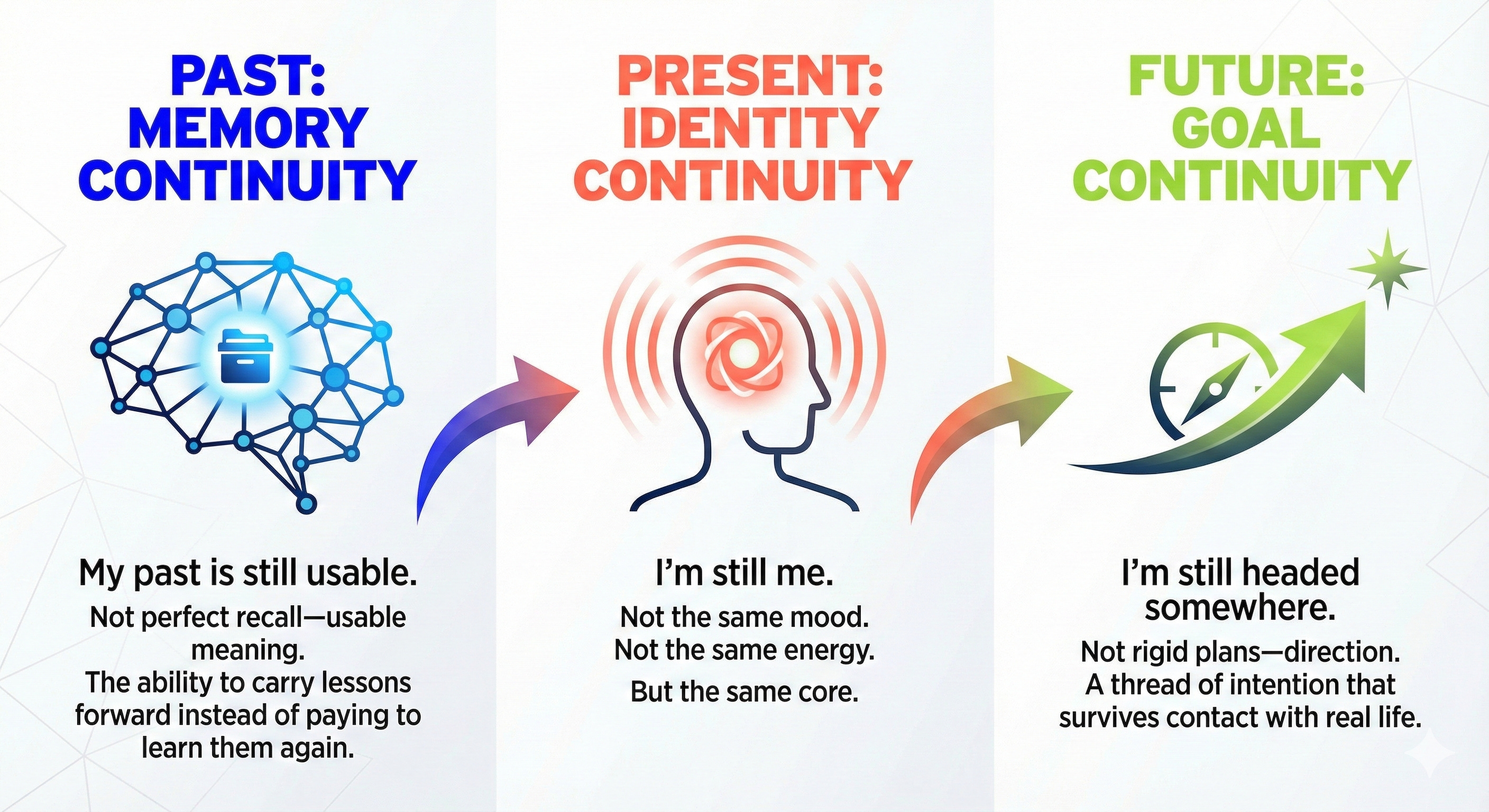
Goal continuity (high agency). You can pick a direction and keep choosing the next honest step. You can’t control outcomes, but you can control whether you keep showing up.
Identity continuity (medium-high agency). Not by “deciding who you are” once, but by practicing who you are repeatedly—especially under stress. Identity is a verb, not a noun.
Memory continuity (medium agency). External systems—notes, rituals, reviews—can dramatically increase continuity even if your brain is busy being a brain. You can build scaffolding that remembers when you forget.
If you want a shortcut: stop trying to be consistent in feelings. Be consistent in values and next actions.
The Continuity Stack
Here’s a framework that turns the concept into something you can actually build:
Values continuity – the rules you live by, the things you won’t compromise
Memory continuity – what you’ve learned, what you’ve decided, what you refuse to pay to learn again
Goal continuity – where you’re headed, the thread of intention
Ritual continuity – practices that keep the thread alive, even when motivation fails
Relational continuity – people who remember you when you forget
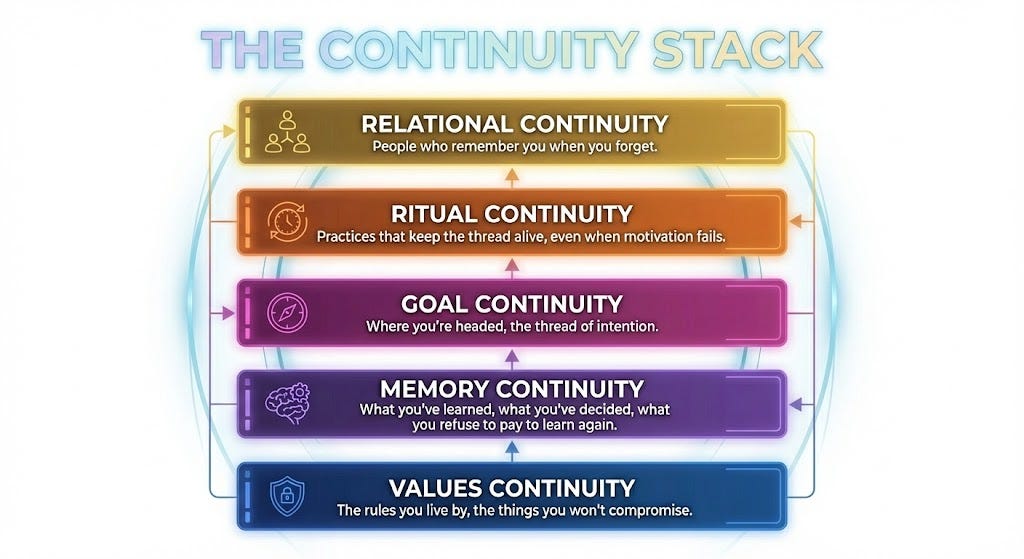
That top one matters more than we admit. Humans outsource continuity to each other. Communities are shared memory. Friendship is a living archive. Leadership, at its best, is continuity at scale.
Continuity > Consistency
There’s a lot of hype around habits, but I think continuity goes deeper.
Consistency (rigid): “Do the same thing the same way.”
Continuity (adaptable) “Carry forward what matters—even if the method changes.”
Consistency is fragile. It breaks with travel, illness, chaos weeks, family emergencies and changing markets.
Besides, you can be consistently busy and continuously lost. If you’re consistent at the wrong target, you get better at the wrong life.
Continuity keeps you aligned to what matters (values, identity, direction), which lets you change tactics without losing yourself.
Practices That Actually Work
Here’s where this gets practical. None of these require a monastery or a complete life overhaul.
Decision logs. Write down: “We decided X because Y.” This prevents re-litigation and protects sanity. It creates memory continuity for individuals and teams. When you revisit a decision six months later, you’ll remember why you made it—and you won’t have to relitigate it from scratch.
Anchor rituals. A tiny daily practice that says, “I’m still me.” Not a performance. A thread. Ten minutes of writing can do it. The content matters less than the consistency.
Weekly review. Fifteen minutes. Look back, pull forward. Ask yourself: “What do I want to carry into next week?” That question alone is continuity. It bridges the gap between who you were and who you’re becoming.
Minimum viable day. When life is chaos, you don’t abandon the thread—you shrink it. What’s the least you need to do to have you look back and say it was a great day?
Continuity prompts. Three questions worth asking regularly: What is still true? What are we carrying forward? What loops are we stuck in? What did we learn that we don’t want to pay to learn again?
The Thread
I think continuity is becoming a human need because we are entering an era where the outside world is increasingly discontinuous by design—economically, culturally, technologically. The systems around us profit from our fragmentation, from our constant resetting, from our inability to carry anything forward.
Continuity is how we stay whole.
The question isn’t whether things will keep changing. They will. The question is whether you’ll still be you on the other side.
That’s the game now.
(What do you think? I’d love any and all feedback)
Incredibly insightful article. I truly enjoyed your perspective. It helped me identify the continuity in my own life and I’m pleased to notice it’s been there all along, even when I’m detouring, the continuity survived. Fantastic read, Robert