

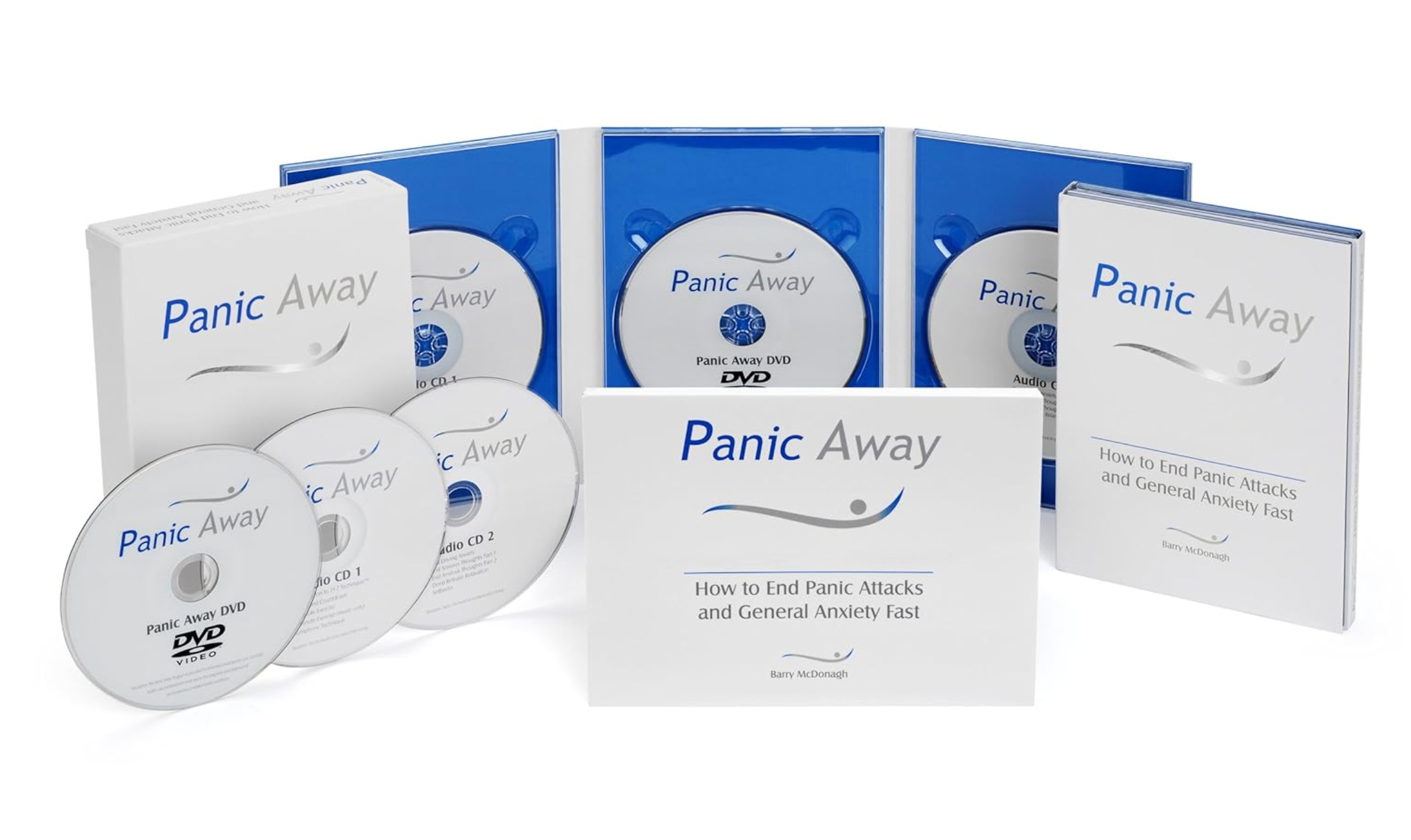
One of the biggest realizations of my life came from learning how to stop a panic attack. Anyone who has ever had one knows the pattern. First, there is the sensation — the tightness, the rush, the feeling that something is wrong. Then comes the thought: This is not good.
And that thought pours gasoline on the fire. The sensation gets stronger. The fear gets louder. The mind starts looking for evidence that the body is in danger, and the body responds to the mind’s alarm, which gives the mind even more evidence that something is wrong. Round and round it goes. A self-reinforcing loop. Until you are in the emergency room, convinced you are dying, only to be told later that nothing was medically wrong
No judgment. I have been there. Anyone who has been there knows I am not exaggerating. (I literally got a $6000 ER bill for a few vitals and some Xanax).
The breakthrough for me came from Barry McDonagh, the creator of Panic Away. (It is no longer for sale, but here are the videos). His approach shocked me when I first heard it because it was the exact opposite of what I wanted to do. He said you cannot merely accept a panic attack. You have to welcome it. You have to invite it in. You tell it to bring it on, tell it to do its worst. You even tell it to kill you. That sounds insane until you try it.
The first time I did, the panic disappeared. Not because I had overpowered it or reasoned my way out of it or escaped the sensation. It disappeared because I stopped fighting the thing that was feeding on my fight.
Resistance was the fuel.
The constraint was not the enemy. My relationship to the constraint was the enemy. And lately, I have been realizing that this applies to a lot more than panic. It applies to creative work, business, discipline, focus, proposals, writing — the work we say matters most but somehow keep finding a way to avoid.
The instinct is to see constraints as something to overcome. Not enough time. Too much mess. Too many obligations. Too much pressure. So we tell ourselves, “I’ll get to the important thing once I clear the deck.” Once the room is clean. Once the email is answered. Once the mood is right. Once the calendar opens. Once the house is perfect and the heavens part and a cinematic beam of divine productivity lands on the desk.
But often, the constraint is not blocking the work. The constraint is revealing the work.
Recently, I caught myself doing the thing. I had something important to work on — a proposal, something real, something with stakes, something connected to the person I am trying to become. And then I started cleaning. Now, cleaning is sneaky because it feels virtuous. It gives you that strange cocktail of pride and guilt. Pride because you are being productive. Guilt because, deep down, you know you are not doing the thing. You are doing a thing. And “a thing” can become the most dangerous substitute for “the thing.”
I caught myself and came back. That alone was progress. Then I drifted again — this time into writing a Substack post that had nothing to do with the proposal. Again, it looked productive. Again, it had enough value to pass as legitimate. Again, it was not the priority. So I pulled myself back.
And this time, I actually faced it. I opened the proposal and started writing. I could feel the fear of getting it wrong sitting right there in my chest, plus the odd resentment that I should even have to write one — as if the work I wanted to do should somehow announce itself without me having to make a case for it.
But I stayed. And after about five awful minutes, the feeling started to leave my body. Not because I had solved anything. Not because the proposal was suddenly good. But because I had stopped running, and the fear lost its grip the same way panic does when you stop feeding it.
Here is what hit me: had I let myself clean, I would have done very little on the proposal, and then I would have justified it by saying, “Well, I only had so much time left after all the other things I had to do.”
But that would have been a lie.
The truth was simpler. I had chosen avoidance and called it necessity. That is what constraints expose. They force the question: what do you really care about? Not what do you claim to care about when the schedule is open and the house is quiet and your inbox is empty. What do you care about when time is tight, the room is messy, your mood is imperfect, and your nervous system is looking for an exit?
That is where the work is.
A constraint is not just a limitation. It is a mirror. It shows you what you worship. Comfort or growth. Avoidance or devotion. Control or contribution. Image or output.
And this is why accepting constraints is not enough. Acceptance is passive. Acceptance says, “Fine, I guess this is happening.” Love is different. Love says, “This is part of the game.” Love says, “This pressure is here to sharpen me.” Love says, “The mess, the deadline, the fear, the audience, the limited time — these are not interruptions to the work. These are the conditions under which the work becomes real.”
Love the deadline because it kills the fantasy version of the project and forces the real one into the world.
Love the audience because it makes you ask whether this actually serves anyone besides your ego.
Love the limited time because it forces priority.
Love the imperfect room because it teaches you that your environment does not get veto power over your purpose.
Love the pressure because it reveals whether you are committed or merely enchanted by the idea of yourself being committed.
This is also how good creators keep moving. They do not get too emotionally tied to one piece. They keep throwing work into the world — testing, learning, adjusting, putting more value out there. They are not hiding in the lab forever, polishing one precious thing until it becomes too heavy to release. They ship. Then they ship again. Not carelessly. Not without standards. But without worshipping the artifact. If something has value, pour gas on the fire. If something does not, learn and move.
The constraint helps because it stops you from pretending you have infinite time to become the person you say you want to be. You do not. None of us do. And weirdly, that is freeing. The deadline frees you from perfection. The mess frees you from waiting. The pressure frees you from drifting. The fear frees you from pretending courage is a feeling instead of a choice.
When panic arrived, the solution was not to run from the sensation. It was to turn toward it and say, “Come on then. Show me what you’ve got.” The same is true of constraints.
The next time one appears, do not merely tolerate it. Do not complain about it. Do not use it as your alibi. Welcome it. Ask what it is here to teach you. Ask what it is forcing you to choose. Ask what version of you it is trying to pull forward.