

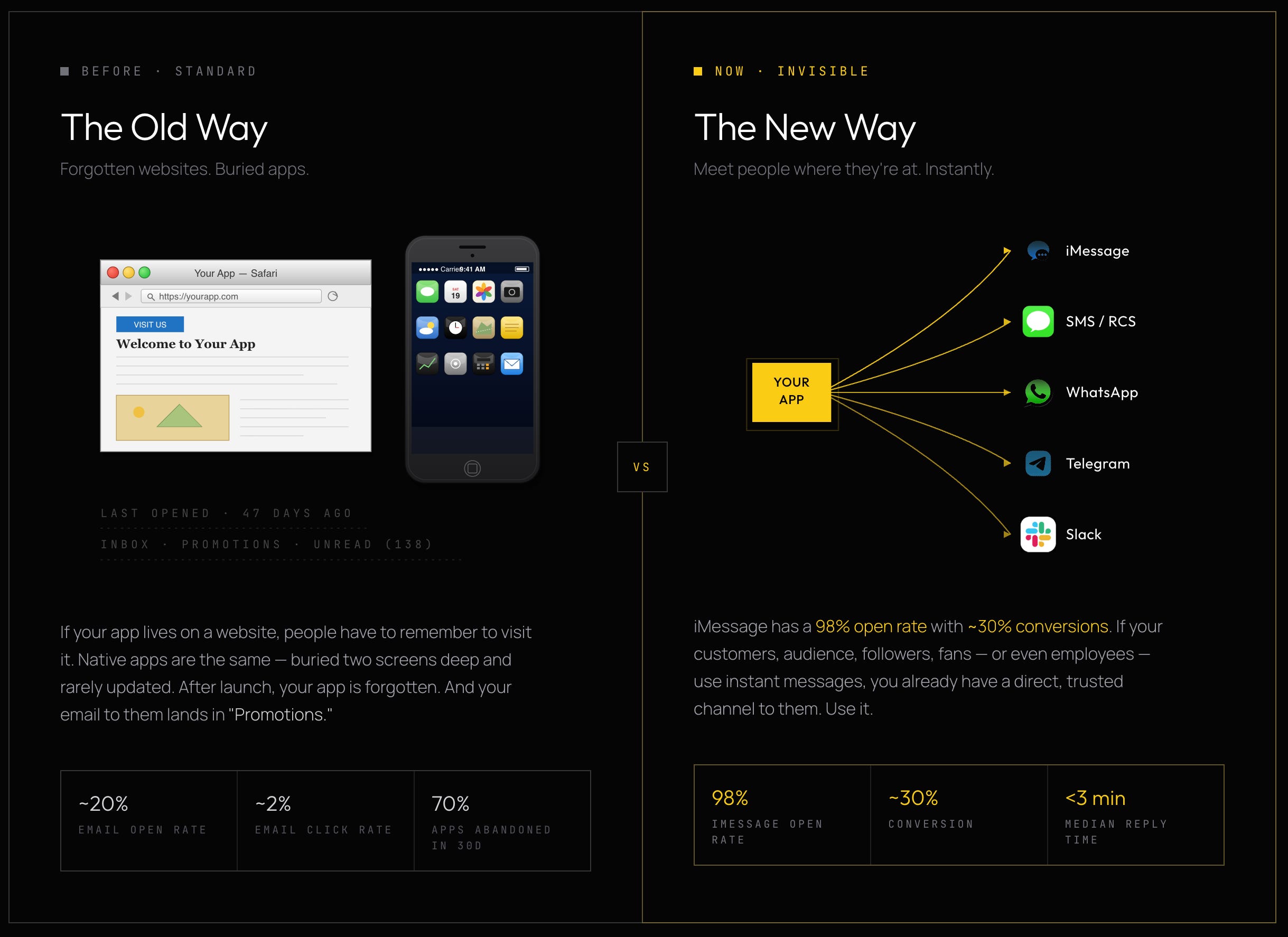
Everyone building AI right now is making the same mistake. They’re building apps — and then trying to convince people to use them.
New login.
New interface.
New learning curve.
Another icon on a home screen that gets used twice and forgotten.
The entire premise is wrong. Not because the AI underneath is bad, but because the delivery mechanisms are completely overcrowded.
Here’s the thing nobody wants to say out loud: the best software doesn’t feel like software. It feels like a conversation you’re already having.
The invisible architecture
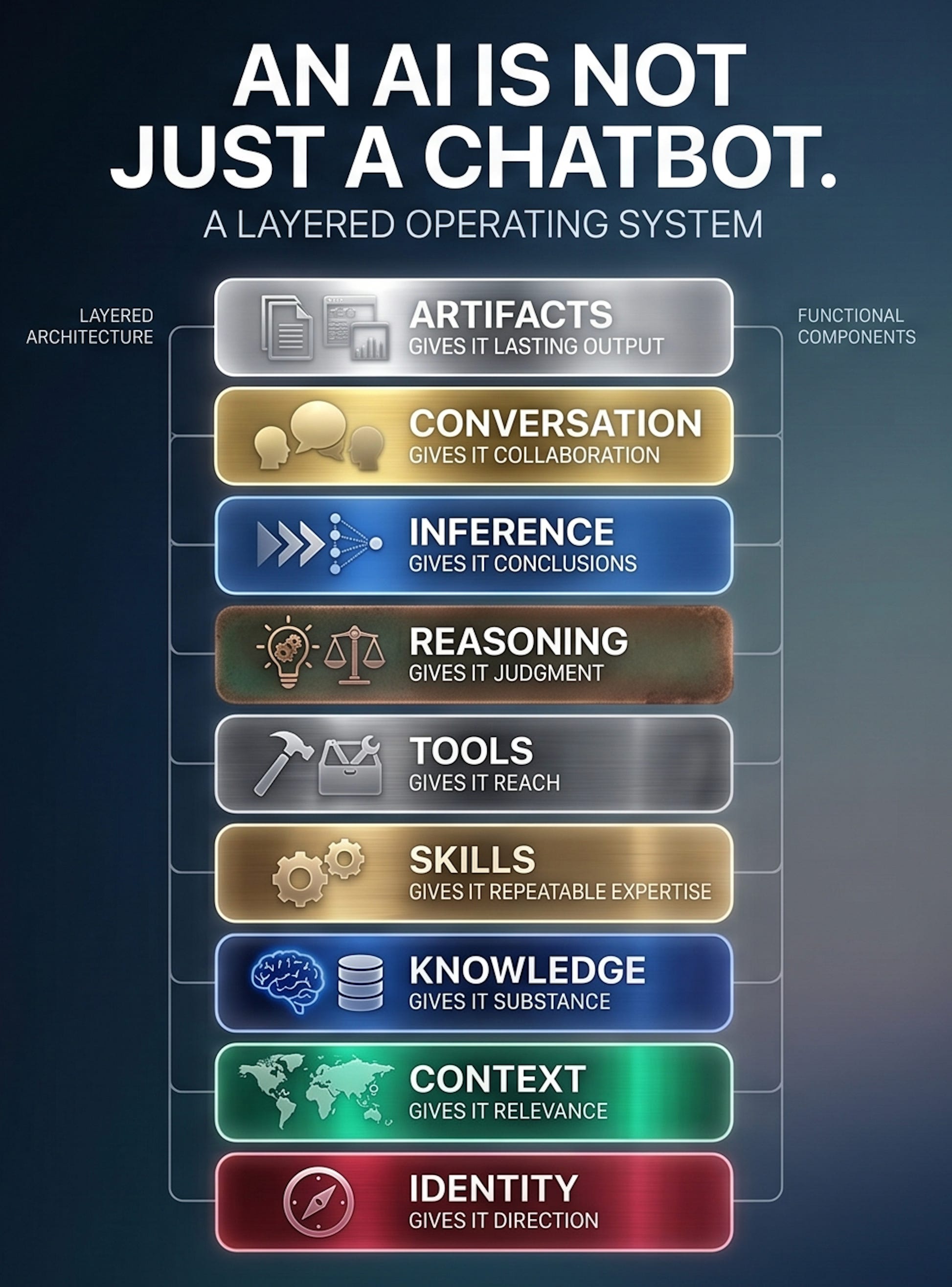
When most people think about AI products, they think in layers — stacked like a cake. Identity at the bottom, knowledge on top of that, reasoning, tools, output. It’s tidy. It makes sense on a whiteboard.
But it misses something fundamental.
Conversation isn’t a layer in that stack. It’s the medium that flows through every layer.
When you treat conversation as just another layer, you end up with chatbots — those hollow interfaces that feel like talking to a form.
When you treat conversation as the product itself, everything changes.
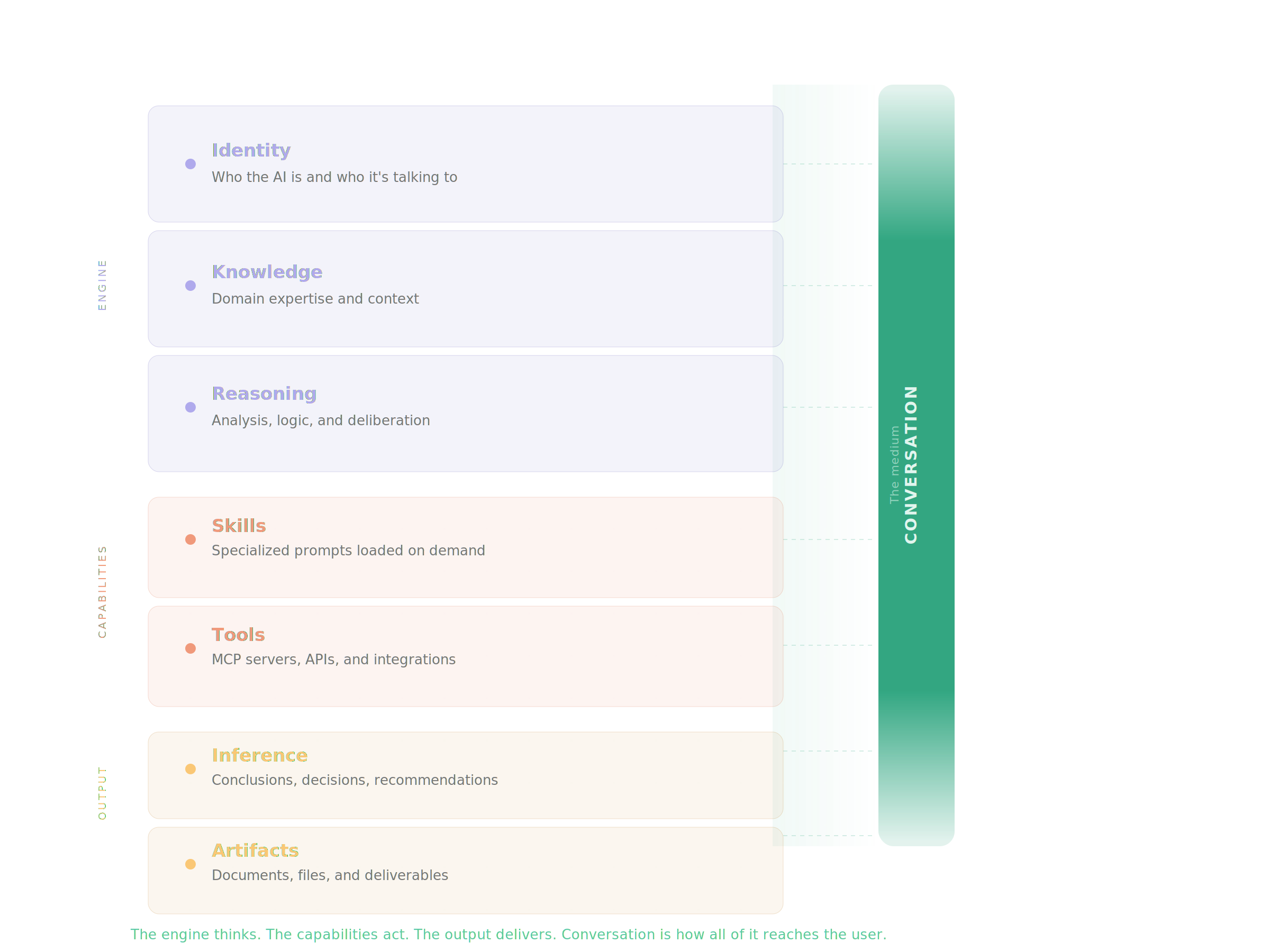
Seven layers, three groups. But conversation isn’t one of them.
Conversation runs alongside the entire stack. It’s not sandwiched between layers — it touches all of them simultaneously. It’s the medium through which identity expresses itself, knowledge gets surfaced, reasoning becomes visible, skills activate, tools execute, inferences arrive, and artifacts land. It’s the I/O bus. The product surface. The only thing the user ever touches.
The iMessage thread. The WhatsApp chat. The Slack channel. No app store. No onboarding wizard. No interface to learn. Just a conversation that somehow knows exactly what you need — because everything underneath is designed to disappear.
Here is a better representation, with three layers.
Why this matters if you’re building something
The obvious objection: “A text thread can’t be powerful enough to run real business logic.”
It can — because behind that thread sits an entire architecture. Identity that knows who it’s talking to and what role it’s playing. Knowledge tuned to a specific domain. Skills that activate contextually. Tools that reach into calendars, databases, CRMs, payment systems. Reasoning that weighs tradeoffs and asks the right follow-up question. Artifacts — real documents, real analyses, real outputs — that arrive right in the thread.
The conversation is the tip of the iceberg. Everything underneath is invisible by design.
The distribution advantage
Other shops build apps you have to convince people to download. We build software that shows up where people already are.
Your users don’t want another app. They want their problem solved in the place they’re already looking. iMessage. WhatsApp. Telegram. Slack. These aren’t distribution channels — they’re the product surface. The AI, the logic, the integrations, the intelligence — all of that is the engine underneath.
This is what invisible system design means. Not invisible as in hidden. Invisible as in so natural you forget it’s there. The system disappears into the conversation, and the conversation disappears into your life.
The best technology has always worked this way. Electricity didn’t ask you to learn a new interface. Running water didn’t require onboarding. The ones that win are the ones you stop noticing.
The distribution advantage
Okay, so yes, a blatant self-promotion here, but I’m really excited about it, and it’s a great offer, so close the tab or deal! :)
After vibe coding a lot (read: Acting as the Quality Assurance department for Ai companies), I started to feel really tired. That’s when my friend Erik offered me a solution to build my iMessage-based dating app.
It’s a perfect process because it involves fast coding with the oversight of engineers:
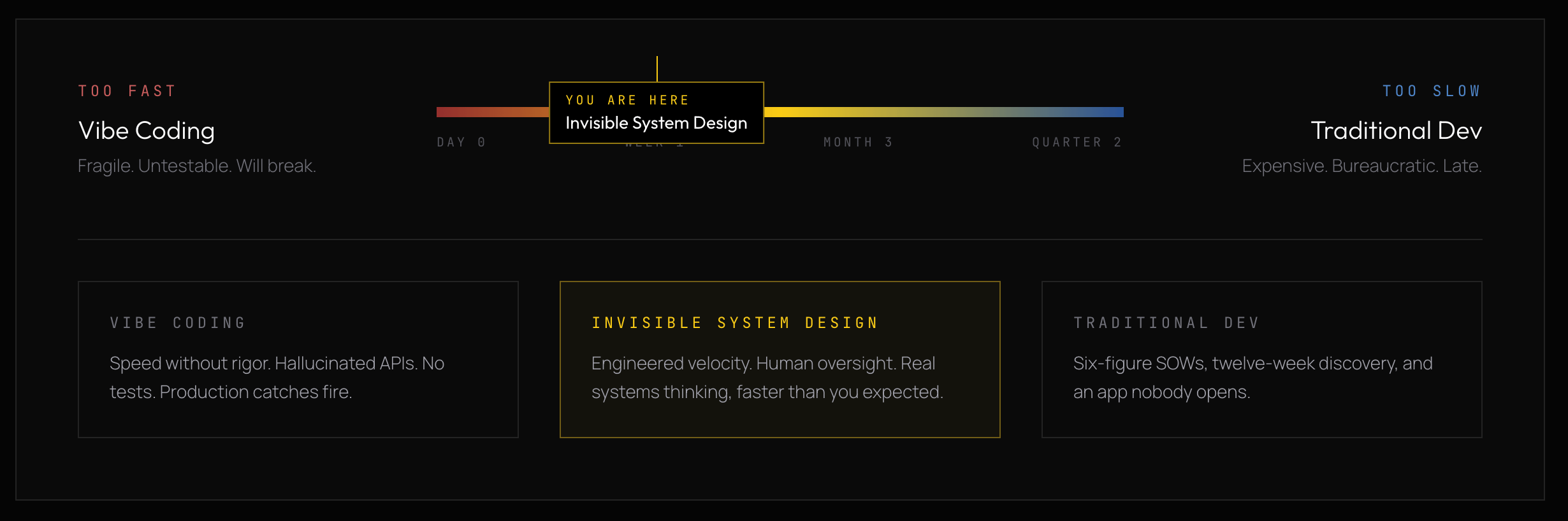
And here’s where retro becomes cool. The changes are done by email. Why? Because it slows down the process, but not too slow. It allows time for real thought instead of just a wild back-and-forth instant exchange.
If you’d like to try it out, let’s talk… www.InvisibleSystem.design
Or if you’re already a builder in the space and want to learn more / talk more, head over to The Conversation Layer.
Love this. I refuse to learn about AI because it feels like another thing to do. But if people want to integrate it into things u am already using, brava!